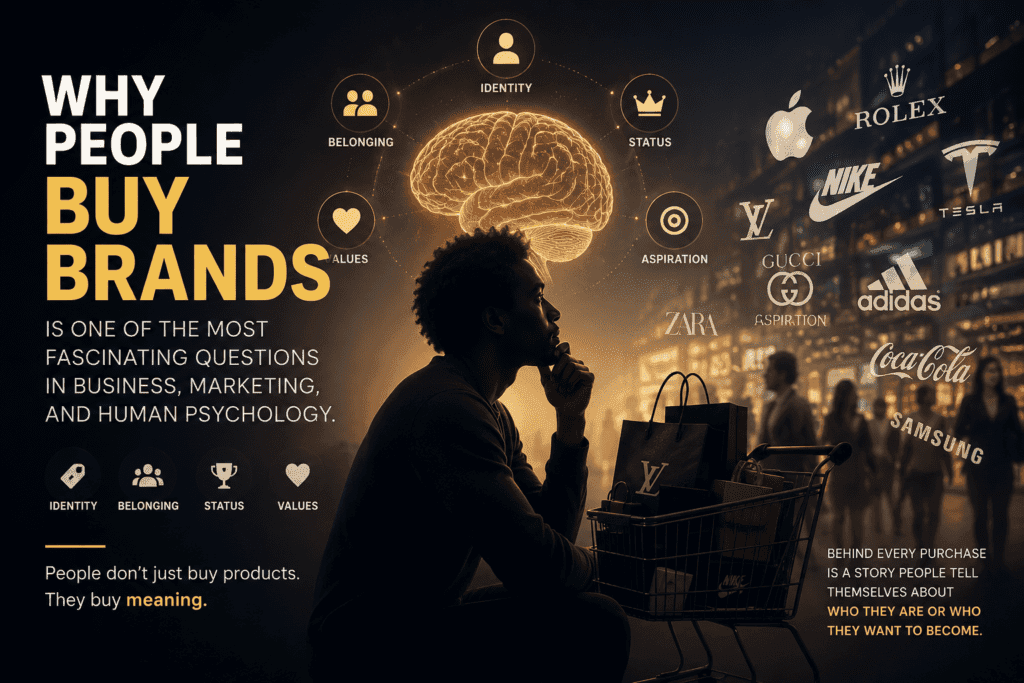
Why people buy brands is one of the most fascinating questions in business, marketing, and human psychology. Walk into a room carrying an expensive designer bag, and now, try walking into the same room carrying a plain plastic bag. Both bags can hold the same items, yet they do not communicate the same thing.

This is one of the most misunderstood truths in business:
People don’t buy products. They buy what products say about them.
Most businesses believe they are selling features, specifications, and functionality. In reality, they are often selling identity.
A Rolex tells time; so does a $20 watch. Yet one costs thousands of dollars while the other costs almost nothing. The difference is not the ability to tell time; the difference is what the watch communicates.
One signals status; the other signals utility. People rarely buy products in isolation. They buy stories, symbols, and social signals.
A Tesla is not just a vehicle; for some people, it signals innovation. For others, it signals environmental awareness. For others, it signals wealth, and the car becomes a statement. The same principle exists everywhere. People buy Apple products because they see themselves as creative, modern, and design-conscious. People wear certain fashion brands because they want to be perceived in a particular way, and people also support specific football clubs because belonging to that tribe becomes part of their identity.
The product becomes a mirror. It reflects how people see themselves or how they want others to see them, and that is why branding matters.
The Hidden Question Behind Every Purchase
Before every purchase, whether consciously or unconsciously, people ask themselves a silent question:
“What does this say about me?”
A person buying a luxury car may not simply be buying transportation; they may be buying recognition.
A person buying the latest smartphone may not simply be buying technology; they may be buying relevance. A person enrolling in a prestigious university may not simply be buying education. They may be buying credibility, belonging, and future possibilities, and humans are social creatures.
We constantly communicate who we are through the things we own, wear, support, and consume. Our purchases become part of our personal story, and this is why products often become symbols, and symbols are powerful.
A symbol can communicate in seconds what words may struggle to explain.
Why Superior Products Often Lose
Many entrepreneurs assume that if they build the best product, people will naturally choose it. Reality is rarely that simple. History is filled with examples of technically superior products losing to products with stronger brands.
Because people do not simply compare features, they compare meanings. A product may solve a problem, but a brand solves a psychological need. People are not only looking for functionality; they are looking for identity, and the strongest brands understand this distinction.
Nike does not sell shoes. Nike sells ambition and discipline, and it also sells the idea that greatness is possible. Luxury brands do not sell leather; they sell status, exclusivity, and social signaling.
Universities do not merely sell education; they sell identity, credibility, and belonging. The product is the vehicle, and the meaning is the destination.
The Psychology of Signaling
Much of consumer behavior is rooted in signaling. People signal success, taste, intelligence, and values. Sometimes they signal these things to others, and most times they signal them to themselves.
That second part is important. Many purchases are not made to impress the world; they are made to reinforce a personal identity. Someone buys running shoes because they want to become a runner and someone buys books because they see themselves as a learner. Someone buys professional equipment because they want to see themselves as serious about their craft.
The purchase becomes evidence of the person they are becoming. In many cases, people are not buying the product.
They are buying a version of themselves.
What This Means for Brands
The businesses that understand this build brands people want to belong to. The businesses that don’t often end up competing only on price. Price competition is difficult because there is always someone willing to charge less.
Meaning is harder to copy. A competitor can copy features, a competitor can copy pricing, and also a competitor can copy design. But it is much harder to copy identity, and that is why some brands maintain loyal customers for decades.
Their customers are not attached to the product alone. They are attached to what the brand represents. The strongest brands become communities, which elevate to becoming tribes, and they become part of how people define themselves.
What This Means for Creators and Entrepreneurs
For creators, entrepreneurs, and business owners, this changes how products should be built and marketed. The question is no longer, “What am I selling?” The question becomes: “What does owning this say about the person buying it?”
Every successful brand eventually answers that question. The answer shapes everything from design to messaging to customer experience, and people don’t remember every feature. They remember how a brand makes them feel and they remember what it represents.
They remember the story attached to it.
The Real Value of Branding
Branding is often misunderstood as logos, colors, and typography. Those things matter, but they are not the essence of a brand.
A brand is meaning, a brand is perception, a brand is identity, and a logo is simply a symbol that carries that meaning. When people connect emotionally with a brand, they are connecting with an idea about themselves.
That connection is what creates loyalty.
That connection is what creates preference.
That connection is what creates value.
Final Thoughts
In the end, products occupy space in our homes. But brands occupy space in our minds, and people may think they are buying watches, shoes, phones, cars, degrees, or handbags. More often than not, they are buying stories.
Stories about status.
Stories about ambition.
Stories about belonging.
Stories about who they are.
Or who they hope to become.
That is why people don’t buy products.
They buy what products say about them.
You can also read: Burna Boy Brand: A Masterclass in Global Positioning
You can also read: Why Starboy’s Silence Is Louder Than Most Headlines: The Power of Wizkid’s Quiet Mastery