
Africa has never lacked resources. From oil and minerals to fertile land and one of the youngest populations in the world, the continent possesses enormous potential. Yet despite these advantages, many African countries continue to struggle with unemployment, poverty, weak infrastructure, and limited industrialization.
For decades, the conversation around Africa’s development has focused on foreign aid, government intervention, and international investment. While these have played important roles, Nigerian entrepreneur Tony Elumelu believes there is another force capable of transforming the continent: African entrepreneurship.
This belief forms the foundation of a philosophy known as Africapitalism.
What Is Africapitalism?
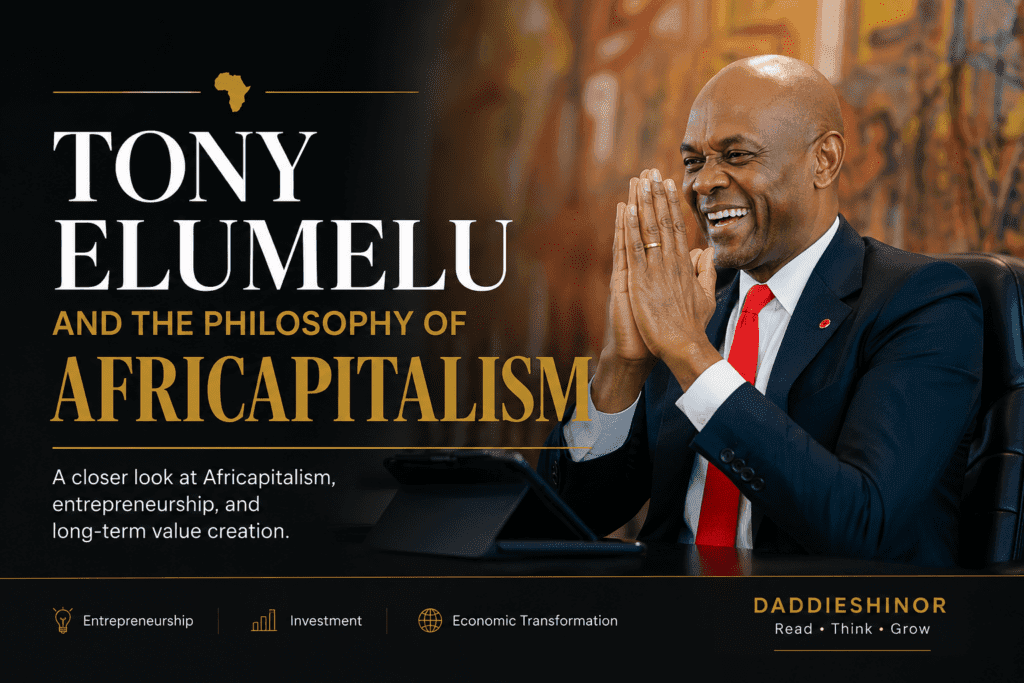
Africapitalism is an economic philosophy developed and popularized by Tony Elumelu.
At its core, Africapitalism argues that Africa’s private sector has both the power and the responsibility to drive economic and social development across the continent.
Unlike traditional views that separate profit from social impact, Africapitalism sees the two as connected. It suggests that businesses can create wealth while simultaneously solving society’s most pressing challenges.
Under this philosophy, entrepreneurs are not merely business owners.
They are builders of industries.
Creators of jobs.
Drivers of innovation.
And ultimately, contributors to national development.
Who Is Tony Elumelu?
Tony Elumelu is one of Africa’s most influential business leaders.
He is the Chairman of the United Bank for Africa (UBA), Heirs Holdings, Transcorp, and the founder of the Tony Elumelu Foundation.
Over the years, he has become known not only for building successful businesses but also for championing entrepreneurship across Africa.
Through the Tony Elumelu Foundation, thousands of African entrepreneurs have received funding, mentorship, training, and support to launch and grow their businesses.
His belief is simple:
If Africa is to prosper, Africans must create businesses capable of generating jobs, solving problems, and creating long-term value.
Why Africapitalism Matters
One of the most interesting aspects of Africapitalism is that it challenges the idea that development should primarily come from outside the continent.
Rather than depending entirely on governments, foreign investors, or aid organizations, Africapitalism places faith in local entrepreneurs and private enterprises.
This approach recognizes a simple reality.
Governments alone cannot create every job.
They cannot build every company.
They cannot innovate in every industry.
Economic growth often emerges from individuals who identify opportunities, take risks, and create value.
When businesses grow, they hire employees.
Employees support families.
Families support communities.
Communities strengthen economies.
The impact extends far beyond the company itself.
Entrepreneurship As A Development Tool
Many people view entrepreneurship as a path to personal wealth. Africapitalism views entrepreneurship as a development strategy, and a successful startup creates more than revenue.
It creates opportunities, and a logistics company improves transportation. A fintech company expands financial access, an agricultural business helps farmers increase productivity, and an energy company improves access to electricity.
Each successful business addresses a specific challenge while generating economic activity. This is why entrepreneurship is often described as one of the most effective tools for sustainable development.
Rather than treating business and social impact as separate goals, Africapitalism encourages them to work together.
Beyond Profit
Traditional capitalism is often criticized for rewarding profit above everything else. Africapitalism introduces a broader perspective.
It encourages businesses to think beyond quarterly earnings and focus on long-term value creation.
This includes:
- Investing in local communities
- Creating sustainable jobs
- Developing infrastructure
- Supporting innovation
- Building industries that last
Profit remains important, and without profit, businesses cannot survive. However, profit is viewed as part of a larger mission rather than the only objective. The goal is to create businesses that generate both economic and social returns.
The African Opportunity
Few regions in the world possess the demographic advantages that Africa currently enjoys. The continent is home to a rapidly growing population, increasing urbanization, expanding internet access, and rising levels of entrepreneurship.
These trends present enormous opportunities. However, potential alone is not enough, and natural resources do not automatically create prosperity. Population growth does not automatically create wealth.
Technology does not automatically solve problems; people do. The future of Africa will largely depend on individuals and organizations capable of transforming opportunity into value.
This is where Africapitalism places its focus.
Not on resources.
Not on aid.
But on people.
Criticisms Of Africapitalism
Like any philosophy, Africapitalism is not without critics. Some argue that private businesses cannot solve every societal challenge, while others point out that governments still play a crucial role in creating stable environments where businesses can thrive.
There are also concerns about inequality, access to capital, and the concentration of economic power among a small number of large corporations.
These criticisms are important, and no single philosophy offers a perfect solution to complex development challenges. Yet even critics often agree on one point:
Entrepreneurship and private enterprise will play a major role in shaping Africa’s future. But the debate is not whether business matters, and the debate is how business should contribute to society.
Can Entrepreneurs Build Africa’s Future?
This is perhaps the most important question Africapitalism raises. Can entrepreneurs become one of the driving forces behind Africa’s transformation?
History suggests that businesses have played significant roles in the development of many economies around the world. Industries create jobs, innovation improves productivity, and investment expands opportunity.
Entrepreneurs identify problems and develop solutions. While entrepreneurship alone cannot solve every challenge facing the continent, it remains one of the most powerful engines for growth and development.
The future of Africa will likely be shaped by a combination of government policy, education, infrastructure, technology, and private enterprise. Africapitalism simply places entrepreneurs at the center of that conversation.
Final Thoughts
Tony Elumelu’s philosophy of Africapitalism offers a powerful idea. What if Africa’s greatest resource is not what lies beneath the ground, but the people capable of building above it?
The philosophy encourages Africans to move from dependency to ownership, from consumption to creation, and from waiting for opportunities to building them.
Whether one fully agrees with Africapitalism or not, its central message remains compelling:
The future of Africa will not be built by resources alone.
It will be built by people who create value from them.
And in that future, entrepreneurs may become some of the continent’s most important nation builders.
You may also be interested in:
• You Don’t Need to Be a Programmer to Start a Tech Startup
• Most Days Discipline Carries You More Than Passion
• Early Success Is a Scam. Great Things Take Time.
• The Internet Made People Brands Before They Became People
• Why Gen Z Doesn’t Trust Luxury Like Millennials Did