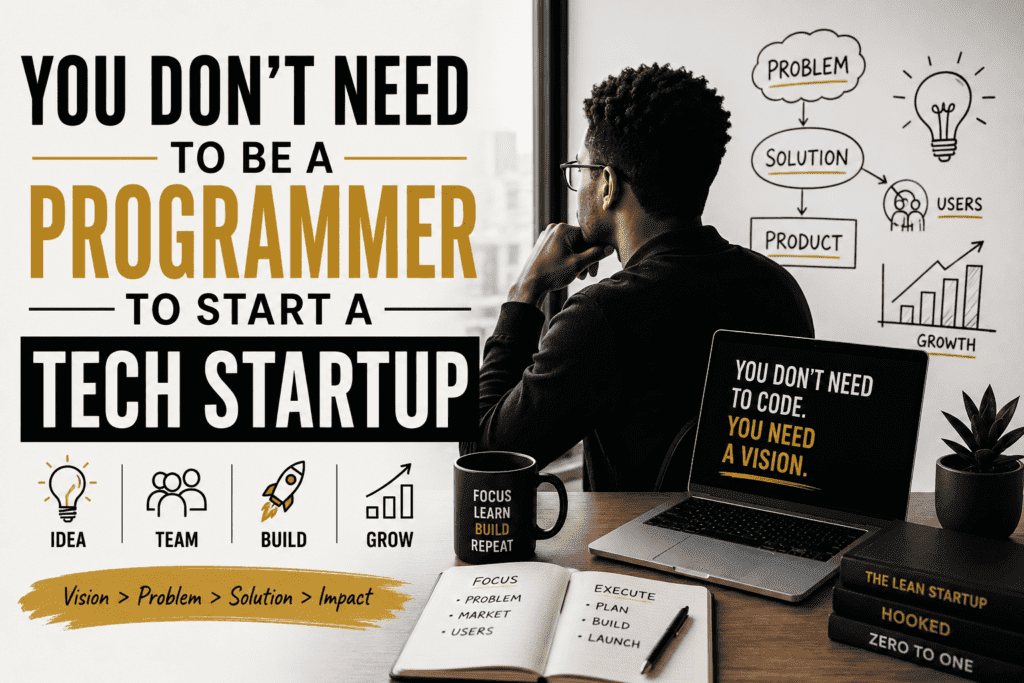
To start a tech startup without coding, you do not need to become a programmer first. You need to understand a real problem, know who has that problem, build a clear solution, and work with the right people who can help you bring the product to life.
One of the biggest myths in technology is that every startup founder must know how to code. This belief has stopped many people from pursuing powerful ideas simply because they are not software engineers.
But a tech startup is not successful because the founder can write code. A tech startup becomes successful because it solves a problem people care about.
Code is important, but code is only one part of the business.
A founder must understand vision, customers, product direction, sales, marketing, operations, partnerships, branding, and leadership. These things matter just as much as development, and sometimes even more.
What Does It Mean To Be A Non-Technical Founder?
A non-technical founder is someone who starts a technology business without being the person who writes the software.
This does not mean the person is clueless about technology. It simply means their strongest skill may not be programming.
A non-technical founder may be good at:
- Understanding customers
- Spotting business opportunities
- Building relationships
- Raising money
- Selling products
- Creating a brand
- Managing people
- Designing user experience
- Explaining the vision
These are serious skills. A startup needs them.
Many technical people can build software, but not all of them can build a company. In the same way, many non-technical founders cannot write code, but they may understand the market better than anyone else.
The goal is not to know everything. The goal is to know what you bring to the table and what you need others to help you with.
Start With A Real Problem
The first step is not looking for developers.
The first step is identifying a real problem.
Many people say they want to start a tech startup, but they begin with an app idea instead of a problem. They say things like, “I want to build an app like Uber,” or “I want to build the next fintech platform.”
That is not enough.
You need to ask deeper questions:
- Who exactly has this problem?
- How are they solving it now?
- Why is the current solution not good enough?
- Are people willing to pay for a better solution?
- How often does this problem happen?
- Is the problem painful enough?
A strong startup begins with pain.
If the problem is not painful, people may like your idea but never use it. If the problem is painful, people will look for a solution.
Learn The Basics Of Technology
You do not need to become a full software engineer, but you should learn the basics.
A non-technical founder should understand things like the following:
- What a website is
- What a mobile app is
- What a backend does
- What a database does
- What an API is
- What hosting means
- What user authentication means
- What payment integration means
- What an MVP is
This basic knowledge helps you communicate better with developers.
It also protects you from being confused, overcharged, or misled.
You do not need to know how to build everything, but you should understand what is possible, what is difficult, and what may take time.
A founder who knows nothing about technology will struggle to lead a tech product. But a founder who understands the basics can ask better questions and make better decisions.
Build An MVP First
Do not try to build the perfect product at the beginning.
Build an MVP.
MVP means Minimum Viable Product. It is the simplest version of your product that allows people to test the core idea.
If you want to build a food delivery platform, your MVP does not need every feature from Jumia Food or Uber Eats.
If you want to build a fintech product, your MVP does not need every feature from Kuda, PiggyVest, or Cowrywise.
Start with the most important feature.
Ask yourself:
What is the one thing this product must do well?
That is where you begin.
Many founders waste money building too many features before they even know if people want the product. A simple version that solves one clear problem is better than a complex product nobody uses.
Use No-Code Tools If Possible
If you are trying to start a tech startup without coding, no-code tools can help you test your idea faster.
No-code platforms allow you to build websites, landing pages, forms, dashboards, and even simple apps without writing code.
You can use tools like:
- WordPress
- Webflow
- Bubble
- Glide
- Airtable
- Notion
- Google Forms
- Framer
These tools may not replace a full technical team forever, but they can help you validate your idea before spending heavily on development.
For example, before building a full marketplace app, you can create a landing page, collect signups, talk to users, and manually connect buyers and sellers.
This may not look perfect, but it helps you prove demand.
Startups are not about looking big from day one. They are about learning fast.
Find A Technical Co-Founder Or Reliable Developer
At some point, if your product needs custom software, you will need technical help.
You can work with:
- A technical co-founder
- A freelance developer
- A software agency
- A small product team
A technical co-founder is useful when the startup depends heavily on technology and you need someone committed for the long term.
A freelancer may be good for a small MVP.
An agency may be better when you need a more structured team, design, development, and delivery process.
But do not just look for someone who can code. Look for someone who understands products.
A good technical partner should be able to explain things clearly, ask useful questions, suggest better approaches, and help you avoid unnecessary complexity.
Know Your Own Role
If you are not coding, what exactly are you doing?
This is an important question.
A non-technical founder must not become a spectator in their own startup.
Your role may include:
- Researching the market
- Talking to customers
- Defining product features
- Creating the brand
- Selling the solution
- Building partnerships
- Raising funding
- Managing operations
- Creating content
- Handling customer support
A founder who cannot code still has serious work to do.
In fact, many startups fail not because the software was bad, but because nobody could sell it, market it, explain it, or get users to trust it.
The product must be built, but the business must also be built.
Do Not Build In Secret Forever
Many people protect their ideas too much.
They are afraid someone will steal the idea, so they keep everything private and build in silence.
But ideas alone are not enough.
Execution is what matters.
You need feedback. You need conversations. You need real people to tell you whether the problem makes sense.
Talk to potential users before building. Show them sketches, landing pages, prototypes, or simple demos. Ask them what they currently use and what frustrates them.
The market will teach you things your imagination cannot.
A startup built only inside your head may feel perfect, but once it meets real users, you will discover what needs to change.
Understand Product, Not Just Idea
An idea is not the same as a product.
An idea is what you imagine.
A product is what people can use.
To turn an idea into a product, you need to think about:
- User experience
- Navigation
- Onboarding
- Pricing
- Security
- Trust
- Speed
- Support
- Design
- Simplicity
This is where many non-technical founders must grow.
You do not need to design every screen yourself, but you should understand how users think and what makes a product easy to use.
A good product is not always the one with the most features. Sometimes it is the one that removes confusion.
Start With One Clear Audience
Do not build for everyone.
A startup that tries to serve everybody usually struggles to connect with anybody.
Choose a specific audience.
For example:
- Small business owners
- Students
- Farmers
- Freelancers
- Churches
- Fashion vendors
- Real estate agents
- Logistics companies
- Local restaurants
- Content creators
When you know who you are building for, your product becomes clearer.
Your messaging becomes clearer.
Your design becomes clearer.
Your pricing becomes clearer.
Your marketing becomes clearer.
The more specific your audience, the easier it is to understand their pain.
Learn To Sell Before You Scale
A startup is not only about building.
You must learn to sell.
Sales does not always mean forcing people to buy. Sales means helping people understand why your solution matters.
If you cannot explain your product clearly, users will not care.
Before you spend money on a big launch, practice explaining your startup in simple words:
- What problem do you solve?
- Who do you solve it for?
- Why is your solution better?
- Why should people trust you?
- How do they start?
If you cannot explain it simply, you may not understand it deeply enough yet.
Avoid Building Too Much Too Early
One common mistake founders make is adding too many features too soon.
They want login, dashboard, wallet, chat, analytics, notifications, referrals, subscriptions, AI, marketplace, admin panel, mobile app, website, and every possible feature from day one.
This can kill the project.
Start small.
Build the core.
Test it.
Improve it.
Then add more features based on real user behavior.
Every feature costs time, money, attention, and maintenance. A simple product that works is better than a complicated product that never launches.
What Non-Technical Founders Must Bring To The Table
If you cannot code, you must bring something valuable.
You should bring:
- Vision
- Market understanding
- Customer access
- Brand clarity
- Leadership
- Sales ability
- Persistence
- Product direction
A technical person should not feel like they are carrying the entire startup alone.
If they build the product, you should be building the business.
That is how the partnership becomes balanced.
Final Thoughts
You can start a tech startup without coding, but you cannot start one without learning.
You must learn the market. You must learn the customer. You must learn the basics of technology. You must learn how products are built. You must learn how to communicate with developers. You must learn how to sell.
Being non-technical is not an excuse to be ignorant.
It simply means your strength is different.
The world does not only need people who can write code. It also needs people who can see problems, understand people, build teams, tell stories, create trust, and turn ideas into movements.
A great startup is not built by code alone.
It is built by vision, execution, patience, teamwork, and the courage to solve a problem that matters.
So if you have an idea, do not wait until you become a perfect programmer.
Start learning.
Start researching.
Start speaking to users.
Start small.
Because you can start a tech startup without coding, but you cannot start one without clarity, courage, and execution.
You might also be interested in: People Are Learning Psychology From Algorithms