
2026 World Cup ball technology is changing football in ways that sounded impossible only a few years ago.
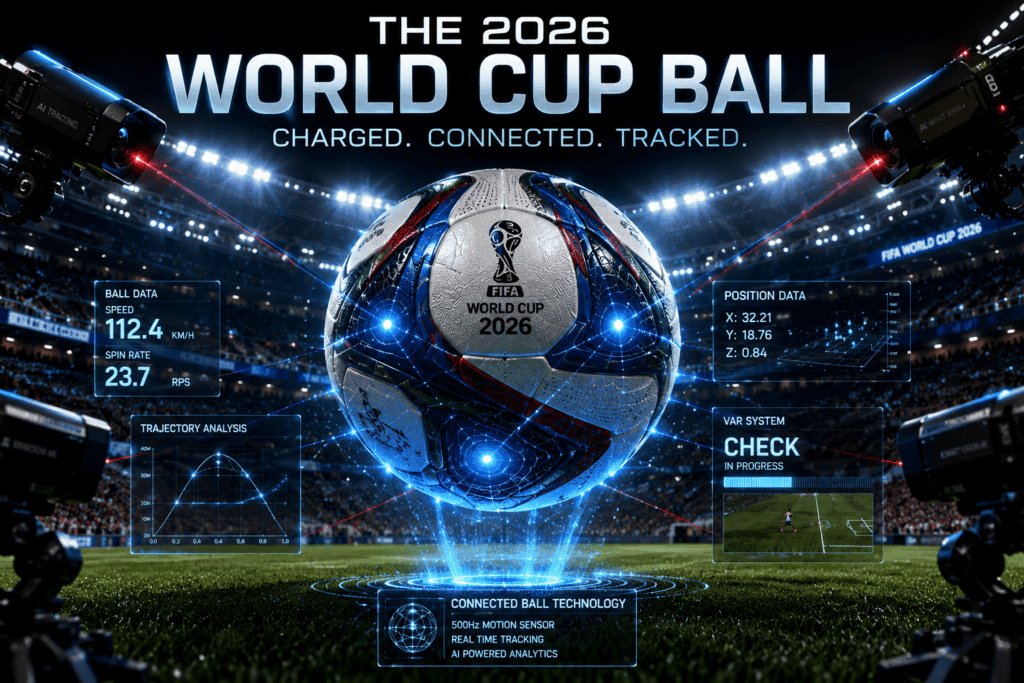
That sentence sounds fake at first. But it’s real. The official 2026 FIFA World Cup ball contains an internal motion sensor that works together with stadium tracking cameras to generate real-time positional data during games.
Yes, the ball now has a sensor inside it.
Yes — it communicates with tracking systems around the stadium.
And yes—the ball needs to be charged before kickoff.
That alone says a lot about where modern sports is heading.
Because football used to be one of the most human sports in the world.
Now even the ball itself became part of a connected digital system.
The World Cup Ball Is No Longer Just A Ball
For decades, football evolved physically.
Balls became lighter.
Boots became faster.
Fields became smoother.
Broadcast cameras became sharper.
But now the evolution became computational.
The 2026 World Cup ball contains connected-ball technology designed to communicate with tracking systems positioned around the stadium.
The sensor inside the ball tracks:
- speed
- movement
- position
- touch data
- trajectory
That information works alongside intelligent stadium cameras that constantly follow the ball during matches.
This helps VAR systems detect events with far more precision than human eyes alone.
In simple terms:
The ball became a data device.
And that changes the emotional meaning of football itself.
Why The Ball Needs Charging
Most people still imagine a football as a completely passive object.
Something physical.
Something mechanical.
Something simple.
But the modern World Cup ball now contains internal electronics.
And electronics need power.
The sensor inside the ball reportedly operates using an internal rechargeable system that must be powered before matches so the connected tracking technology functions correctly throughout the game.
That means somewhere before kickoff…
someone is literally charging footballs.
That sounds almost absurd until you realize how much modern sports now depends on data.
Football Is Becoming A Real-Time Data System
This is bigger than sports equipment.
It reflects something happening across modern society.
Everything is becoming measurable.
Phones track movement.
Watches track sleep.
Cars track behavior.
Algorithms track attention.
Now football tracks the ball itself in real time.
The game is increasingly becoming a live computational environment where cameras, sensors, software systems, and AI-assisted decision-making operate together simultaneously.
And honestly…
most fans probably do not fully realize how technological modern football already became.
VAR Changed Football Forever
Before VAR, football arguments lasted for years.
People debated:
- offside goals
- handballs
- penalty decisions
- controversial moments
Human error was part of football culture.
Sometimes painful.
Sometimes legendary.
But VAR changed the emotional structure of the sport.
Now football operates inside a system where precision matters more aggressively than ever before.
And connected-ball technology pushes that even further.
Because the system no longer relies only on camera angles.
The ball itself now participates in the tracking process.
That is an entirely different technological era.
The Ball And The Cameras Work Together
One of the most fascinating parts of this technology is that the ball does not operate independently.
The sensor works together with intelligent tracking cameras installed around the stadium.
Those cameras constantly monitor:
- player movement
- ball position
- acceleration
- interactions
- spatial positioning
The sensor inside the ball sends data rapidly while the cameras visually interpret movement from multiple angles at once.
Together, they create a much more detailed understanding of what is happening on the field in real time.
That allows officials to make faster and more accurate decisions during critical moments.
Especially for:
- offsides
- touches
- deflections
- handball incidents
- tight goal-line situations
Football is slowly becoming part sport…
part computational analysis.
The Strange Psychology Of A “Smart Football”
There is also something psychologically strange about this moment.
For generations, football represented simplicity.
You could play football:
- barefoot
- on rough streets
- inside dusty compounds
- on broken concrete
- with improvised balls
Especially across Africa, football always felt deeply human.
Raw.
Emotional.
Accessible.
But now the highest level of football includes:
- sensor systems
- predictive tracking
- connected infrastructure
- intelligent cameras
- real-time analytics
The contrast feels surreal.
A child can still play football barefoot in Lagos…
while the official World Cup ball itself operates like a smart device.
That says a lot about the future of sports.
Technology Is Entering Every Emotional Human Space
This is what makes the story bigger than football.
Technology is no longer staying inside computers alone.
It now enters:
- sports
- relationships
- creativity
- entertainment
- identity
- culture
- emotions
The modern internet era transformed ordinary objects into connected systems.
Even a football is no longer just physical.
It became informational.
And once objects become informational…
they become trackable.
Measurable.
Analyzable.
Optimizable.
That is the world modern technology is building.
Will Football Lose Its Human Feeling?
This is the question many fans quietly ask.
As football becomes increasingly data-driven, some people fear the sport could lose part of its emotional unpredictability.
Football was always beautiful partly because humans were imperfect.
Referees made mistakes.
Players reacted emotionally.
Chaos created legendary moments.
But technology increasingly attempts to reduce uncertainty.
The problem is:
football is emotional before it is technological.
And balancing those two things may define the future of sports itself.
Final Thought
The fact that the 2026 World Cup ball needs charging before matches sounds like science fiction.
But it’s real.
And maybe that moment symbolizes something much bigger than football.
The world is entering an era where even ordinary objects are becoming intelligent systems connected to data networks, cameras, algorithms, and real-time analysis.
The football stopped being just a football.
It became part of the machine.
And honestly…
That might be one of the clearest signs yet that the future already arrived.
Read more technology and internet culture stories on Daddieshinor.
Also Read: Tech Industry Secrets: Things Most People Don’t Know