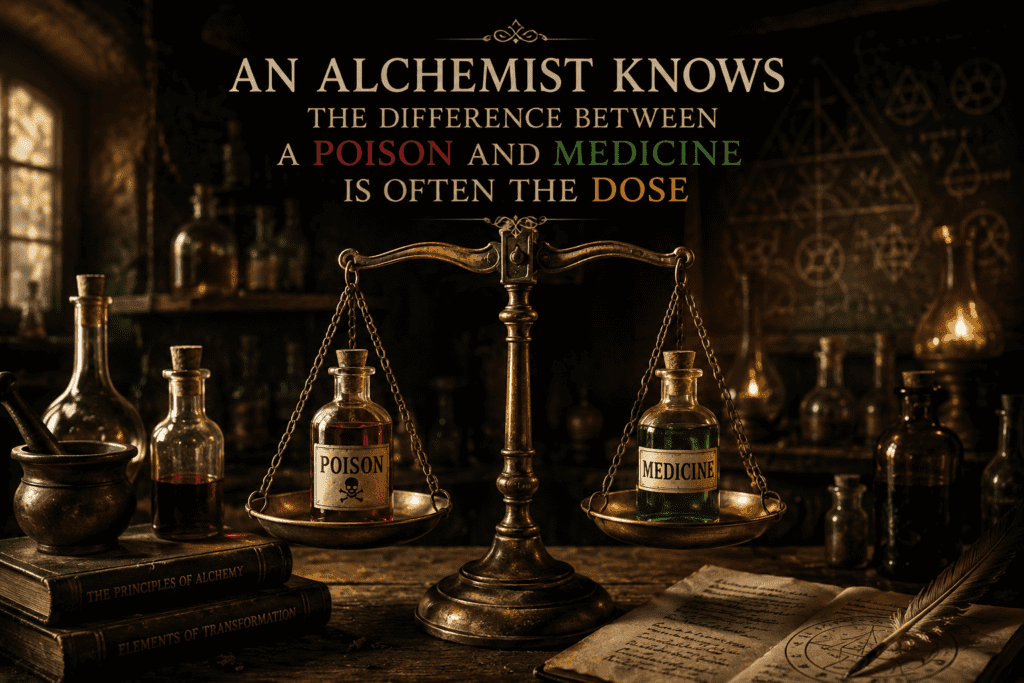
The wisdom of moderation is one of the oldest lessons in human history. It teaches that many good things become harmful when taken too far, and that balance often matters more than excess. There is an old idea associated with alchemists:
The difference between a poison and a medicine is often the dose.
At first glance, it sounds like a statement about chemistry.
In reality, it may be a statement about life.
Water keeps us alive.
Too much water can kill.
Confidence helps us succeed.
Too much confidence becomes arrogance.
Work creates opportunity.
Too much work destroys health.
Money provides freedom.
Too much obsession with money can create a different kind of prison.
Many of the things we celebrate are not inherently good.
Many of the things we fear are not inherently bad.
The difference is often the amount.
The difference is often the context.
The difference is often the dose.
Modern Life Rewards Extremes
One of the strange characteristics of modern culture is its obsession with more.
More productivity.
More content.
More followers.
More hustle.
More growth.
More success.
The assumption is that if something is good, then more of it must be better.
But nature rarely works that way.
Sunlight helps plants grow.
Too much sunlight can destroy them.
Exercise strengthens the body.
Too much exercise can damage it.
Even medicine becomes dangerous when consumed beyond the intended amount.
Yet modern life often encourages us to maximize everything.
Few people ask a different question:
When does enough become too much?
When Strengths Become Weaknesses
Many of our greatest strengths contain the seeds of our greatest weaknesses.
Discipline is admirable.
But excessive discipline can become rigidity.
Confidence is attractive.
But excessive confidence can become arrogance.
Patience is valuable.
But excessive patience can become passivity.
Ambition drives progress.
But excessive ambition can become obsession.
The qualities that help us succeed often become dangerous when left unchecked.
This is why wisdom matters.
Knowledge tells us what something is.
Wisdom tells us how much of it to use.
The Dose Is Often the Difference
Technology is a useful example.
The internet has given humanity access to more information than any previous generation could imagine.
It has created opportunities, careers, businesses, and communities.
Yet the same technology can also produce distraction, addiction, anxiety, and information overload.
The technology itself is not the problem.
The dose often is.
Social media can connect people.
Social media can also consume people.
Work can create meaning.
Work can also consume life.
Food can nourish.
Food can also harm.
The difference is often not the thing itself.
The difference is how much of it enters our lives.
The Hidden Art of Balance
Balance is often misunderstood.
Some people think balance means avoiding ambition.
Others think balance means avoiding risk.
But balance is not the absence of intensity.
Balance is the ability to recognize limits.
An experienced driver knows speed can be useful.
They also know speed can be dangerous.
An experienced investor knows confidence is necessary.
They also know overconfidence can be expensive.
An experienced leader knows authority is important.
They also know too much authority can become control.
The most mature people are not necessarily those who avoid powerful things.
They are often the people who know how to handle powerful things responsibly.
Why Ancient Wisdom Still Matters
There is a reason similar ideas appear throughout different cultures and philosophies.
Ancient thinkers repeatedly warned against excess.
Not because they feared success.
Not because they opposed pleasure.
But because they understood human nature.
Humans are often tempted to believe that more is always better.
History repeatedly proves otherwise.
Civilizations have collapsed from excess.
Companies have collapsed from excess.
Individuals have collapsed from excess.
Many failures do not begin with bad things.
They begin with good things taken too far.
The Wisdom of the Alchemist
Perhaps the alchemist’s lesson was never really about poison or medicine.
Perhaps it was about understanding life.
The challenge is not always deciding what is good and what is bad.
The challenge is recognizing when something beneficial becomes harmful.
The challenge is knowing when to continue.
And knowing when to stop.
In a world constantly encouraging us to pursue more, that may be one of the rarest forms of wisdom.
Because sometimes the difference between growth and burnout, confidence and arrogance, freedom and chaos, medicine and poison…
Is simply the dose.
Related Reading: Why People Don’t Buy Products. They Buy What Products Say About Them